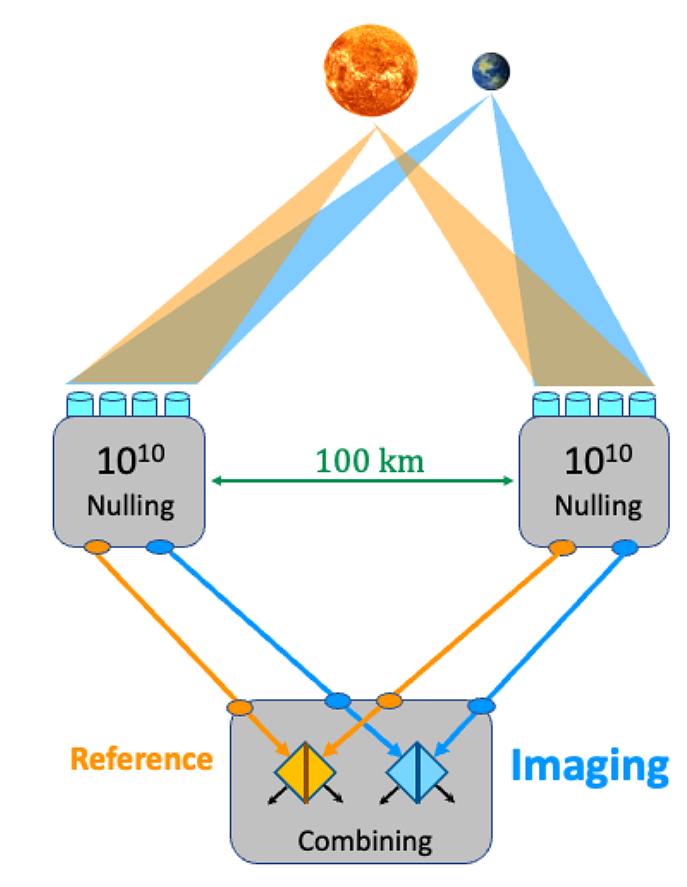
NASA is funding research into a new type of nulling interferometer, called “dynamic hierarchical nulling,” with the goal of directly imaging the surface features of Earth-like exoplanets in visible light. The project aims to reconstruct images of these distant worlds and resolve details on their surfaces.
The scientific objective, as stated by Paul Stankus of Brookhaven Science Associates, is "reconstructing the image, ie resolving surface features, of an Earth-like exoplanet around a nearby star as seen in visible light." This ambitious goal requires innovative technology to overcome the challenges of observing faint planets orbiting bright stars.
The proposed approach centers on a two-stage innovation. The first stage involves designing and implementing this new “dynamic hierarchical nulling” interferometer, which will combine inputs from multiple telescopes. Details about the specific telescope configuration or operational timeline were not provided in the source material. However, the project represents a significant step towards potentially mapping continents – or similar features – on exoplanets.
We don't rate truth. We strip the spin and show you which perspectives covered the story. You decide.
Read the original coverage
💬 Comments
📜 Comment Policy