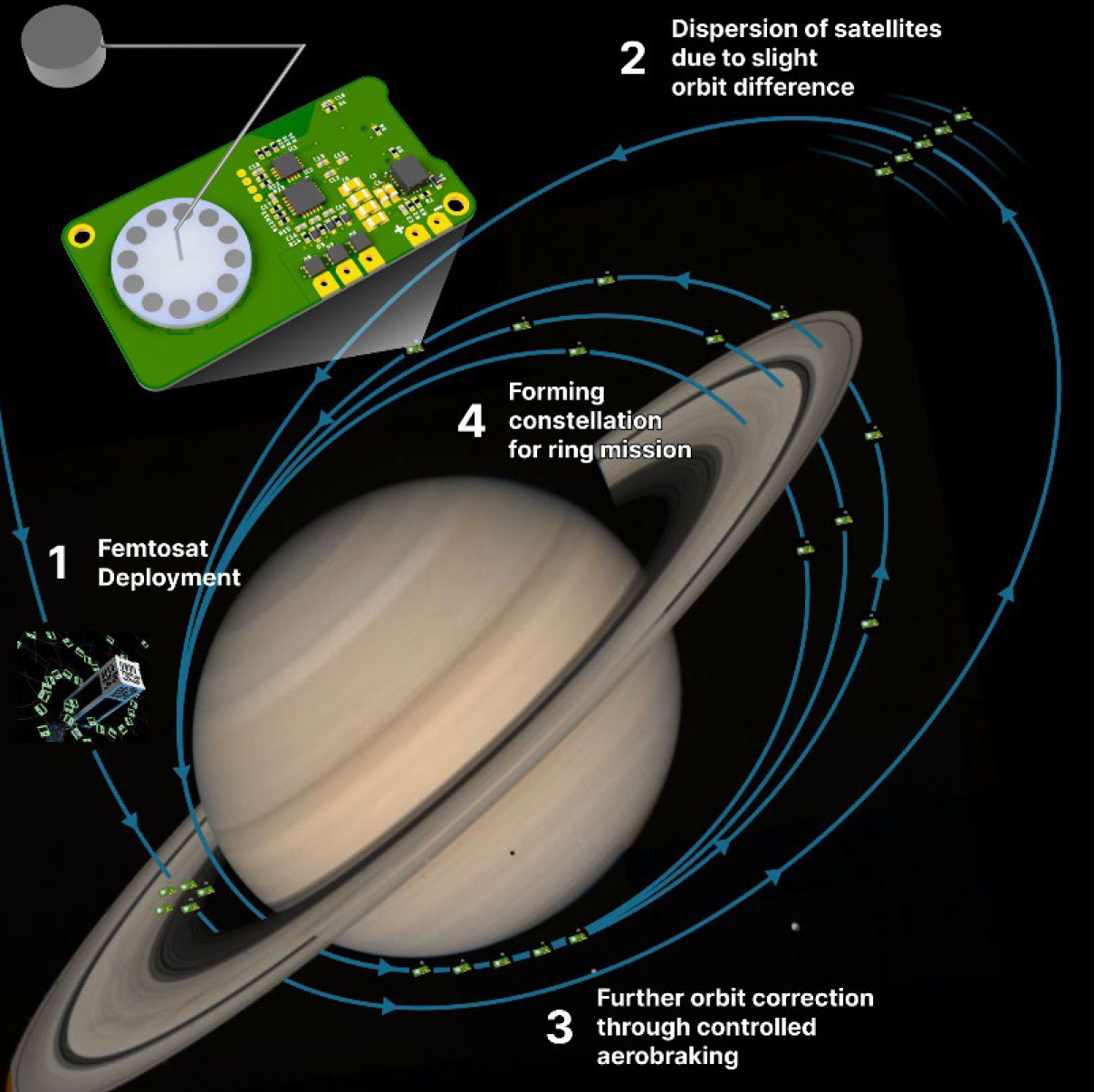
Northwestern University is proposing a mission to deploy approximately 10,000 actively steerable femtosats to study Saturn’s rings, atmosphere, and magnetosphere. The initiative aims to conduct in-situ surveys of these features with a significantly reduced risk compared to traditional single-flagship missions.
The proposed mission, spearheaded by Michael Rubenstein of Northwestern University, Chicago, would utilize a large constellation of femtosats – extremely small satellites – to map the composition of Saturn’s rings and atmosphere, as well as the distribution of its magnetic field. The concept centers around in-situ exploration, meaning direct observation within the environment being studied.
The proposal highlights the inherent risks associated with sending a single, large spacecraft like Cassini to explore Saturn's rings. According to the source material, “Conducting in-situ surveys of Saturn’s rings with a single flagship mission… would carry an unacceptably high risk of mission failure due to […].” The femtosat approach is intended to mitigate this risk by distributing the observational burden across numerous small satellites, making the loss of any individual unit less impactful to the overall mission success.
The plan involves actively steering these femtosats, allowing for targeted data collection and a comprehensive understanding of Saturn’s complex systems. Approximately 10,000 femtosats would be deployed to achieve this detailed mapping.
We don't rate truth. We strip the spin and show you which perspectives covered the story. You decide.
Read the original coverage
💬 Comments
📜 Comment Policy